

Collectible card boosters are sealed packs or sachets that contain a set number of surprise cards, designed to create anticipation and encourage collecting. While traditionally associated with card games such as Magic: The Gathering or Pokémon, boosters have become an effective marketing tool for brands across industries looking to generate engagement through collection-based mechanics.
Origin and evolution of the concept
Boosters emerged in the 1990s alongside the rise of Trading Card Games. The idea was simple yet powerful: sell cards in opaque packs where the buyer does not know the exact contents, creating an element of surprise and randomness that drives repeat purchases to complete collections.
From games to marketing strategies
What began as a distribution format for card games has expanded into multiple sectors: supermarkets launching themed collections, sports brands with team stickers, food products including promotional cards, and cultural events offering limited series.
Supermarket collections in Spain (animals, football players, movie characters) have shown that boosters work beyond the traditional gaming audience. Entire families take part in collecting, generating recurring store traffic and increasing average basket size.
Components of a booster
A typical booster consists of several elements that work together to create the full experience.
The envelope or packaging
The pack protects the cards and creates the first impression. It can range from a simple metallized paper wrapper to premium packaging with special closures, transparent windows or tactile elements.
The material must protect the cards from moisture and damage while remaining easy to open. The exterior design communicates the collection, builds anticipation and often includes information about card types or the number of cards included.
The cards
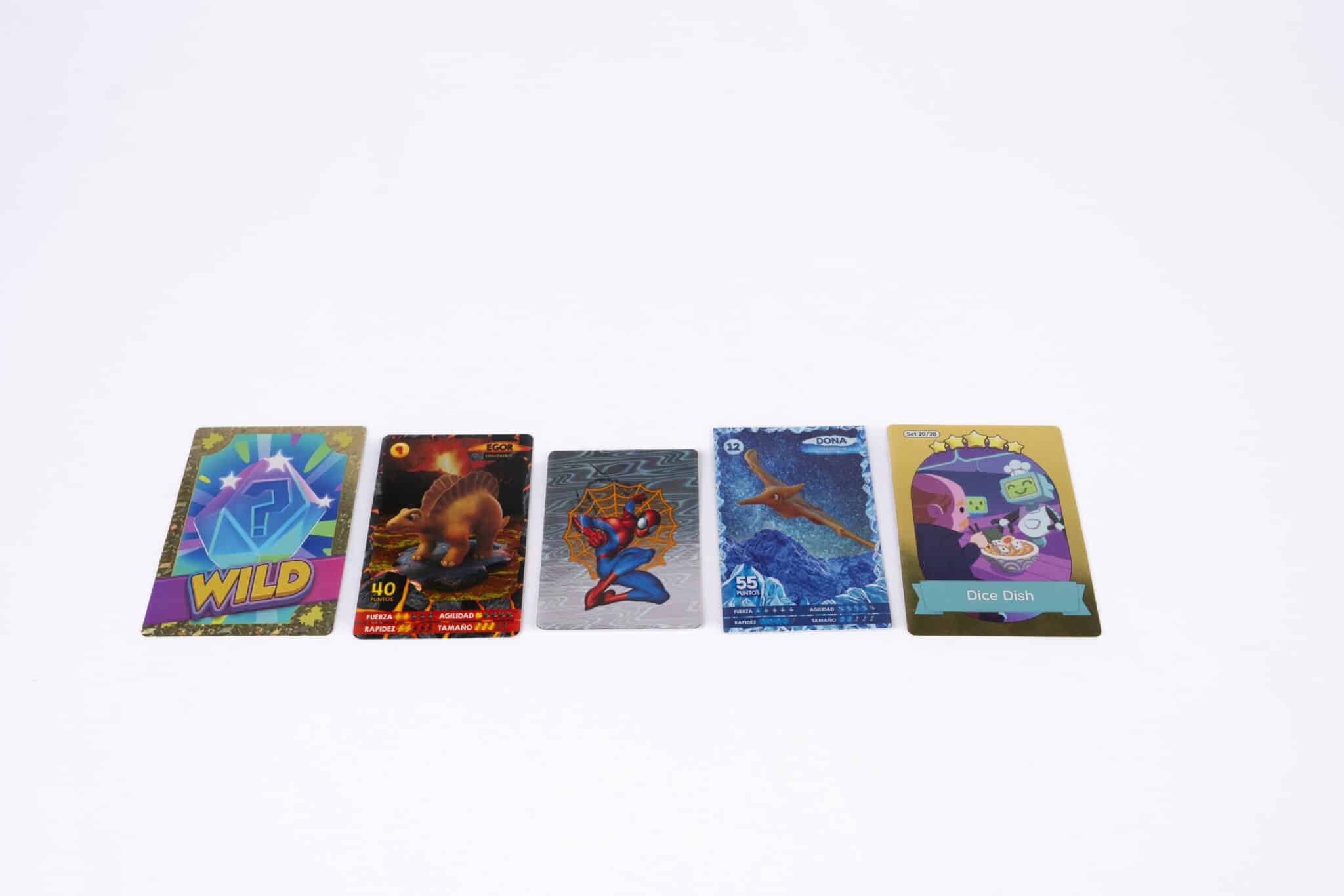
Each booster contains a fixed number of cards (typically between 5–15) with a predefined distribution of card types. Print quality, paper material and special finishes (holographic, metallic, UV varnish) are critical to perceived value.
Typical distribution structure:
- Common cards: 60–70% of the content
- Uncommon cards: 25–35%
- Special cards: 5–10%
- High-end special cards: 1–3%
This distribution ensures that completing the collection requires opening multiple boosters, encouraging repeat purchases without overly frustrating collectors.
Optional additional elements
Some boosters include extras that increase perceived value: digital code for online content, mini-poster, sticker, booster-exclusive promotional card, or information about the complete collection.
Collecting mechanics that work
Some boosters include extras that increase perceived value: digital codes for online content, mini-posters, stickers, exclusive promotional cards, or information about the full collection.
Controlled randomness
Buyers roughly know what they will get (X common cards, Y uncommon cards, probability of special cards) but not exactly which ones. This mix of certainty and uncertainty keeps interest high.
Too much randomness frustrates (spending €50 without getting any valuable cards). Too little removes excitement. Successful collections carefully balance probabilities to maintain engagement without causing excessive frustration.
Visible identification system
Cards include clear indicators of category (symbols, colors, special finishes). This allows collectors to quickly identify value and facilitates trading between collectors.
Achievable complete collection
Although completing a collection requires effort (and spending), it should remain achievable without excessive cost. Collections of 50–200 different cards are common, typically requiring 30–100 boosters to complete statistically.
Applications in marketing and promotions
Brands use boosters as a loyalty and recurring traffic generation tool.
Loyalty programmes in retail
Supermarkets and hypermarkets launch themed collections (typically 2–4 per year) where customers receive a free booster for every X euros spent. This encourages more frequent purchases, higher basket value, repeat visits during the campaign, and participation from the whole family.
Well-executed campaigns can increase visit frequency by 15–25% and average basket size by 10–15% during the collection period.
Product launches
Brands release card collections linked to new products: movies, series, video games or sports teams. Boosters act as official merchandise that generates additional revenue and amplifies the reach of the main product.
Events and experiences
Festivals, sports or cultural events create commemorative collections. Boosters become a physical souvenir and can include access to exclusive content or participation in giveaways.
Booster production: technical considerations
Producing boosters at scale requires specific technical capability and precise logistical coordination.
Card printing
Collectible cards require high-quality printing on specific paper (typically 300–350 gsm) with special finishes for special cards. Color consistency across runs is critical: cards of the same type must look identical regardless of when they were produced.
With over 50 years of experience in specialized printing, Grifoll masters collectible card production: high-quality offset printing on specific papers, precise color management, special finishes (holographic, metallic, selective UV varnishes) and precision die-cutting with rounded corners.
Bagging (flow pack)
The process of inserting cards into sealed packs requires specialized machinery that groups cards according to the desired distribution, inserts them into the pack, seals it hermetically and verifies weight/thickness to detect errors.
Grifoll offers a complete automated packaging service with integrated quality control, ensuring that each booster contains exactly the specified configuration and is properly sealed.
Quality control and traceability
In large collections, quality control is essential: verifying that the distribution meets specified probabilities, detecting printing or die-cutting defects, batch traceability to identify the source of any issue, and auditing to ensure no exact duplicates within the same booster.
Grifoll’s role in booster projects
Grifoll Print Solutions provides a complete solution for brands looking to launch card collections: from design and production to packaging and logistics.
Design and consulting: Grifoll’s team advises on optimal distribution, effective collection sizes, special finishes that convey value and distribution logistics.
Card production: Offset printing on specialized papers, special finishes (holographic, metallic, selective UV varnish), precision die-cutting and strict quality control.
Packaging: Configuration of distribution per booster, automated packaging with content verification, hermetic sealing and packing into master boxes for distribution.
Volume flexibility: from pilot runs of 2,000–5,000 boosters to validate the concept to large-scale productions of millions of units for national campaigns.
Conclusion
Collectible card boosters are much more than envelopes with cards: they are marketing tools that leverage collecting mechanics to generate engagement, recurring traffic and emotional connection with brands or events. The success of a booster project depends on multiple factors: attractive card design, balanced rarity distribution, production quality, efficient logistics and a deep understanding of the mechanics that maintain the interest of the collector.
Grifoll Print Solutions combines technical production capability (printing, special finishes, bagging), experience in projects of different scales and a consultative approach that helps brands design collections that meet marketing objectives while offering a satisfying collecting experience.
Are you considering launching a collectible card collection?
Our team can advise you on collection design, rarity distribution, finishes that communicate value and production logistics. With full printing and bagging capability, and more than 50 years of experience, we guarantee solutions that combine technical quality with marketing effectiveness.
